
COSMIC CALLS
Lunar Logistics & Service System | 2025 | UX Case Study
Project Overview



Understanding the Issue
Scope
Set in 2050, global space agencies and corporations have begun establishing bases on the Moon to explore and mine valuable resources. The newly formed settlement, Moontown, faces major logistical challenges:
No established roads or transport networks
Limited access to essential goods and services
Harsh environmental conditions (low gravity, no atmosphere, extreme temperatures)
Technology must remain low-tech due to radiation damage risk
To support settlement growth, Cosmic Calls were tasked with:
Designing a manual cargo-launching system
Creating a transport solution to move goods through Moontown
Developing a functional station to deliver services, value, and safety to settlers
These three challenges explored how lunar resource handling, distribution, and on-site service delivery could operate efficiently under real constraints.
Process
We followed an iterative Design Thinking approach:
Empathise
Researched astronaut needs (mobility, dexterity, safety) and lunar constraints (low gravity, radiation, no atmosphere).
Define
Identified the need for lightweight, portable, low-tech solutions and accurate, protected, hands-free cargo movement.
Ideate
Explored concepts inspired by Earth systems (catapults, rail networks, distribution hubs) and mapped user journeys.
Prototype
Built multiple low-fidelity prototypes using cardboard and found materials; iterated rapidly.
Test
Measured launch accuracy and distance, improved delivery safety, and assessed the station’s usability and feasibility.
Solution
To tackle the three challenges, our team conducted an iterative design process combining research, ideation, prototyping, and testing:
Research & Insights: Analysed lunar settlement conditions, terrain challenges, and end-user needs. Reviewed existing systems and low-tech alternatives that could work in low-gravity, extreme environments.
Ideation & Concept Development: Brainstormed multiple solutions for each challenge, creating sketches, physical models, and low-fidelity prototypes to explore form, function, and usability.
Prototyping: Built functional and conceptual prototypes using materials such as cardboard, rubber bands, and 3d printing for physical models.
Testing & Iteration: Tested each prototype against real-world lunar constraints and end-user scenarios. Adjusted designs to improve reliability, efficiency, and user interaction.
Team Management: As project manager, I coordinated tasks, maintained timelines, and ensured team alignment across all three challenges, keeping development on track.
Key Insights
Lunar settlements lack infrastructure: no roads, scarce resources, and long travel distances between outposts.
The Moon’s low gravity and no atmosphere enable long-distance launches but remove aerodynamic control, requiring safer impact-resistant cargo.
Systems must be manual, low-tech, lightweight, and easy to operate, as astronauts have limited dexterity and mobility.
Cargo must be secure on launch and landing, with simple loading and safe retrieval by only two crew members.
Distribution must integrate with key Moontown areas (mining, manufacturing, farming, research, resettlement) to support settlement growth.
How can we simplify and condense the key insights into goals?
Using key insights from the Moontown brief, contextual research, and prototyping observations, we identified a wide range of user needs and environmental constraints. To make these manageable, we synthesised findings and aligned them with the critical functional requirements of lunar settlement logistics.
The key goals included:
Enable Safe + Accurate Cargo Transport
Create Low-Tech, Manually Operated Systems Suitable for Spacesuit Use
Ensure Cargo Protection Throughout Launch, Landing + Handling
Develop Modular + Scalable Systems for Future Outpost Growth
Improve User Interaction at Loading + Distribution Points
Support Operational + Economic Feasibility for Moontown Services
Challenge 1 — Cargo Launcher
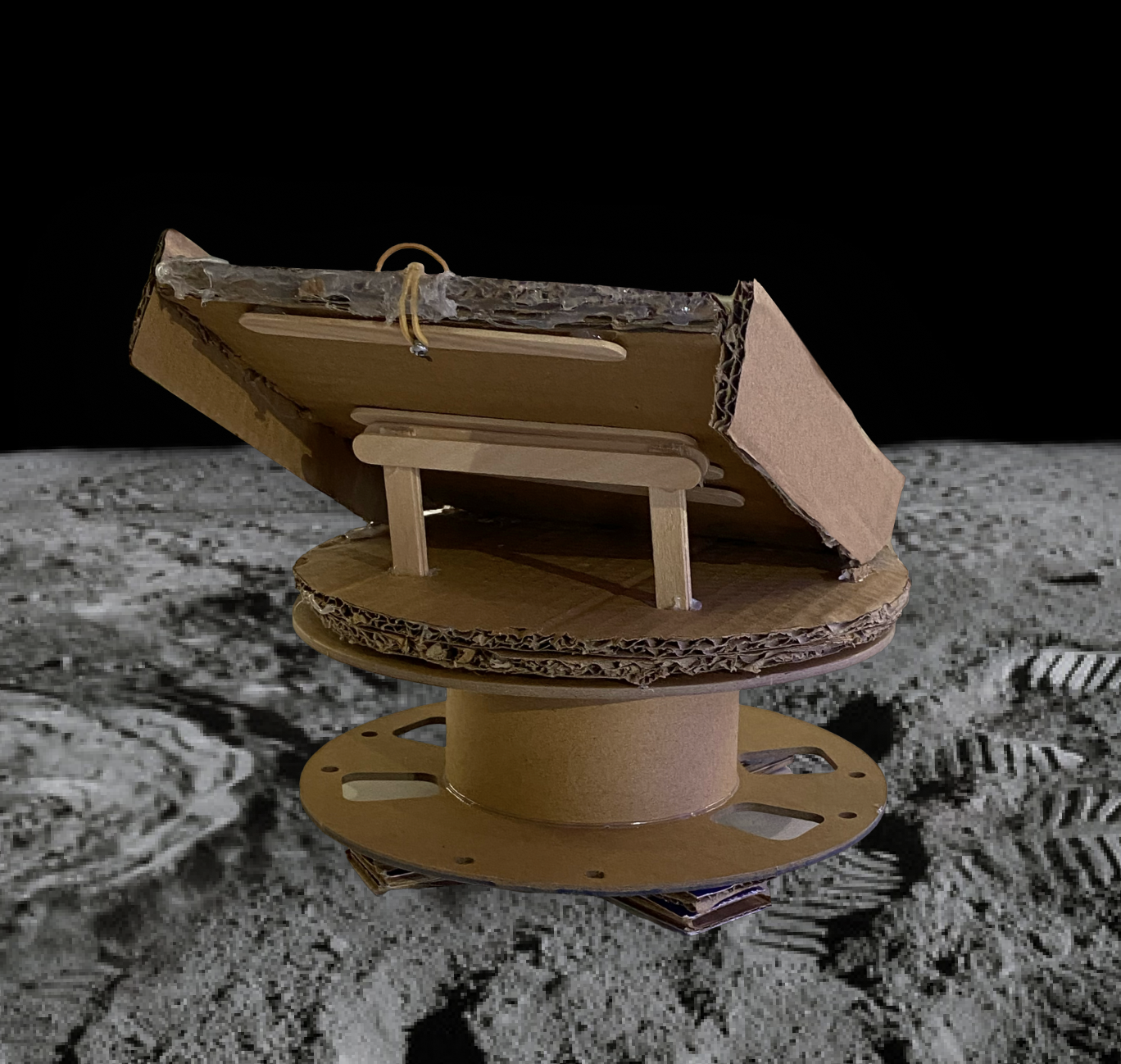
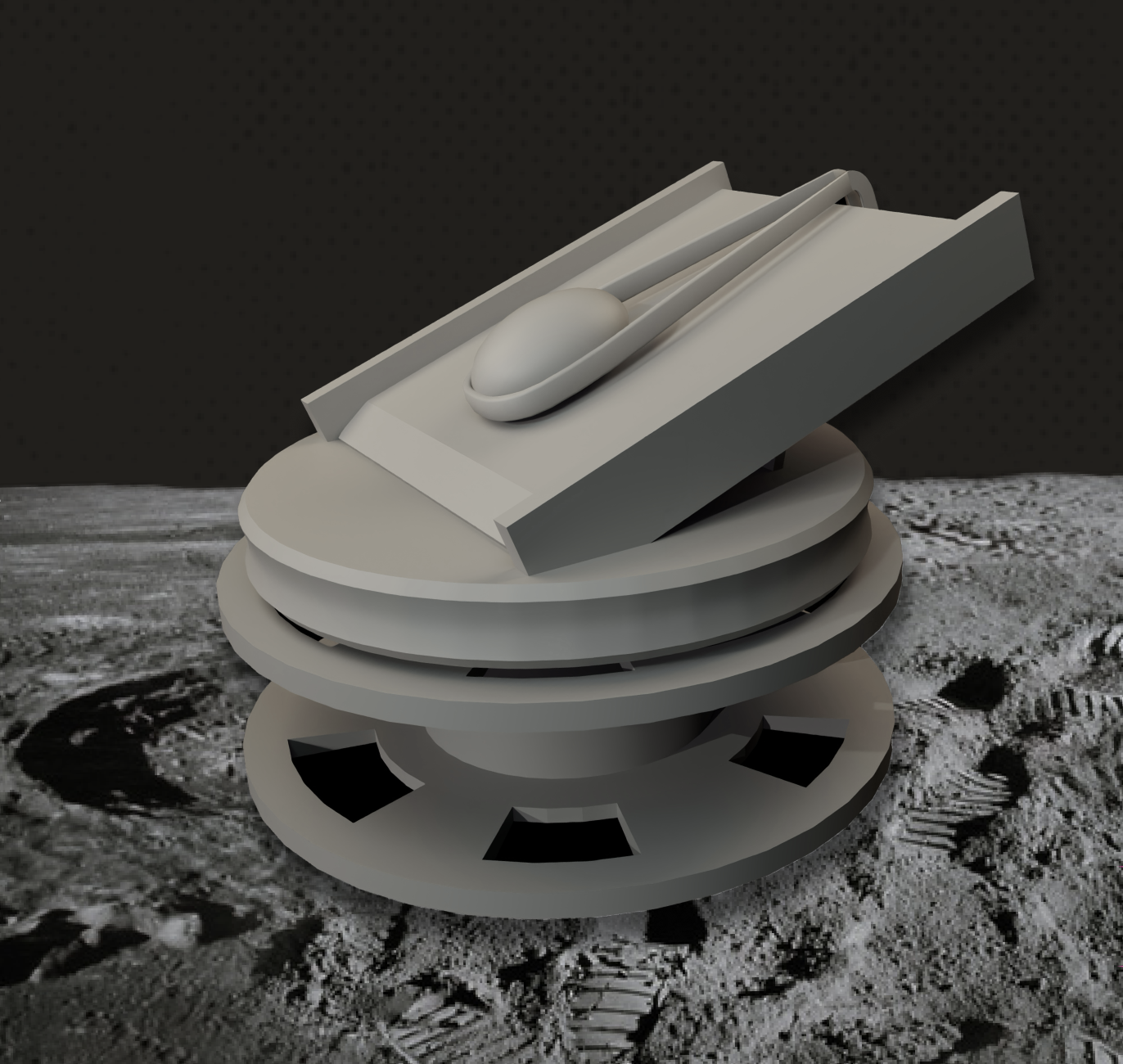
A manual slingshot-based launcher was developed, leveraging lunar low gravity and no drag:
Elastic-powered mechanism based on naval catapult principles
Adjustable height + rotational base for directional control
Constrained launch channel for increased accuracy
Cargo designed with rounded edges + internal hatch for impact protection
Minimal materials ensured low-cost fabrication
Result: Cargo could be launched safely and consistently between outposts with only two operators.
Implemented Solution
Defining Goals
Implemented Solution
Implemented Solution
Challenge 2: Cargo Transportation System
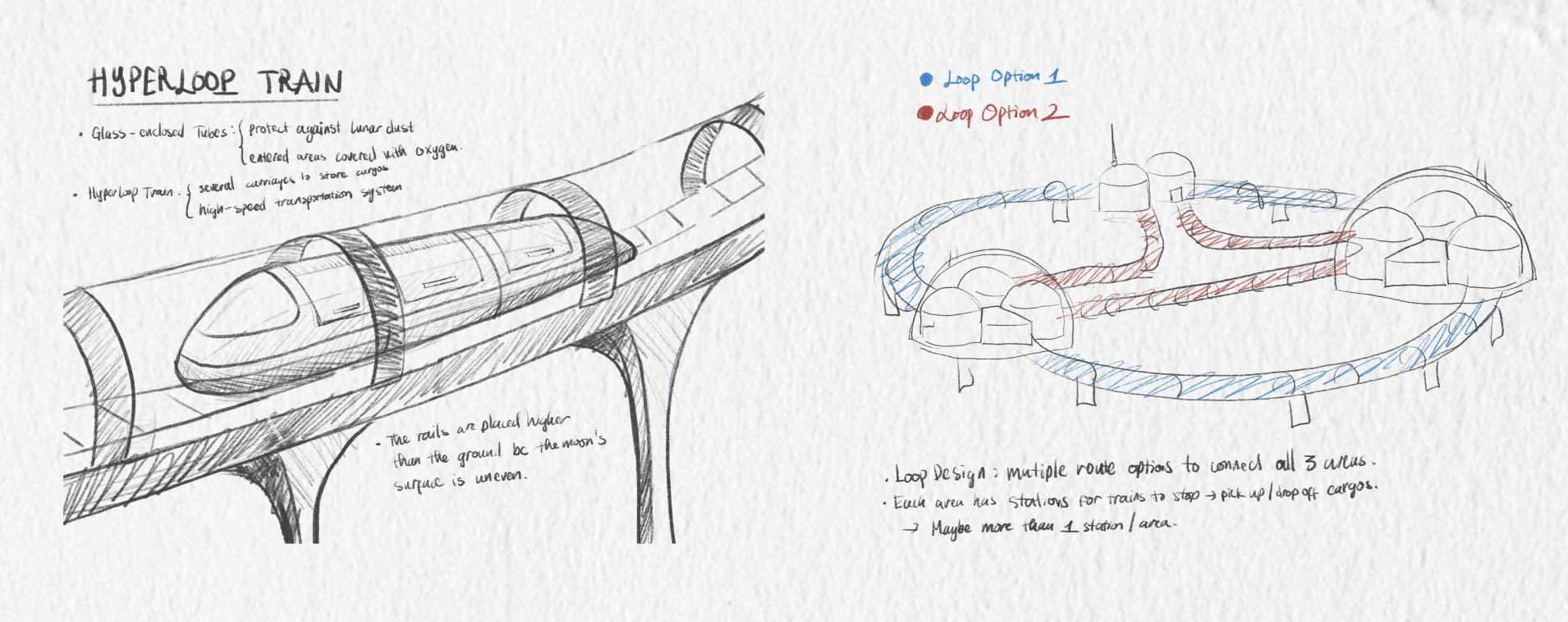
We designed a modular transport system to move cargo from the distribution warehouse to Moontown facilities. Key features include:
Multi-destination route covering mine, farm, and research centre.
Physical prototype built from classroom materials to test form, scale, and functionality.
Considered lunar terrain, energy efficiency, and hands-free delivery requirements.
Iterative prototyping and evaluation refined vehicle design for stability, reliability, and adaptability.
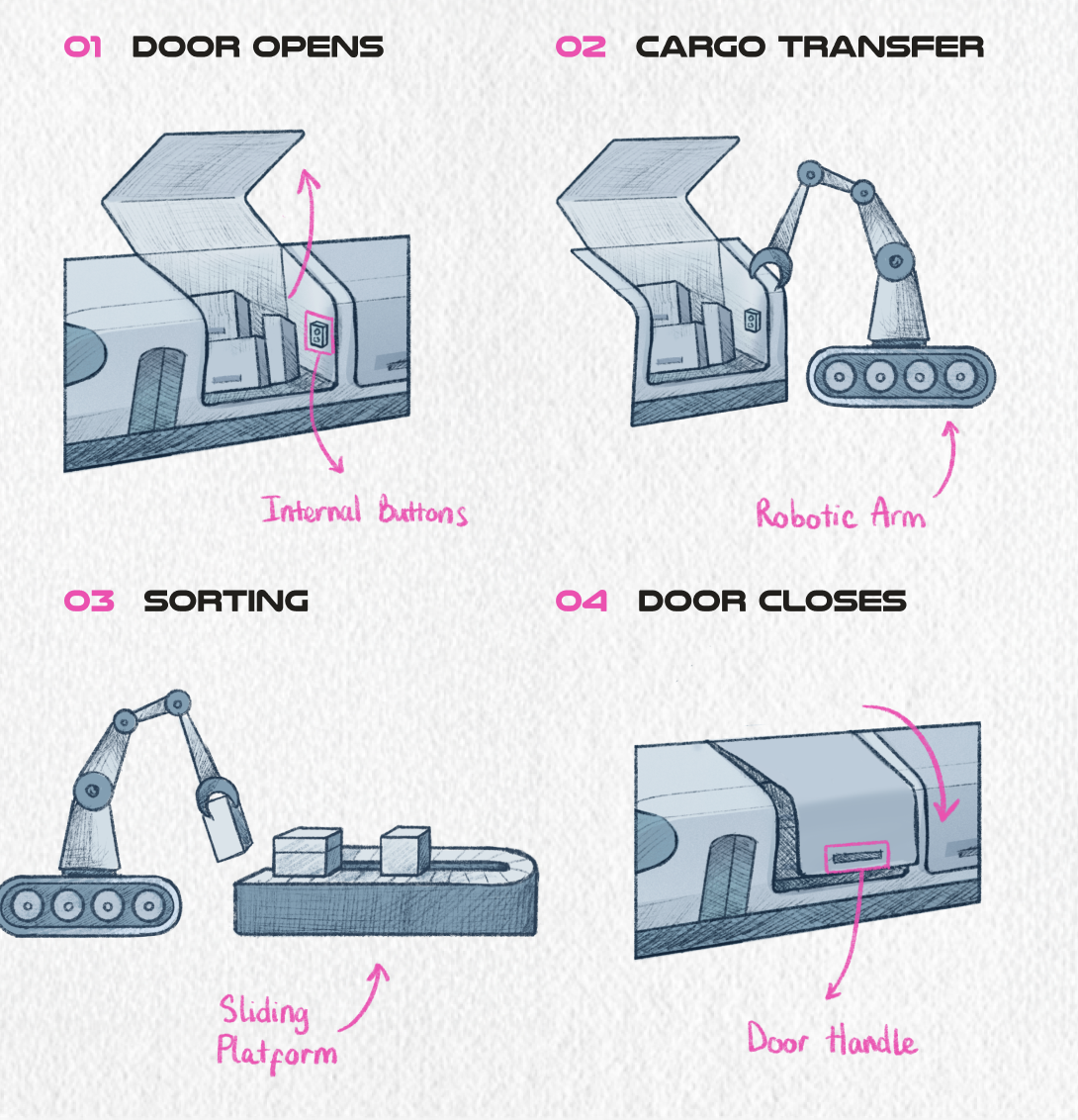
Challenge 3: Moontown Station Design
We designed a fully functional station to support the cargo transport system. Key features include:
Scaled interior and exterior considering lunar conditions and user interactions.
Loading bays, scheduling, and payment systems integrated for efficiency.
User journey mapped to ensure intuitive, safe, and accessible operation.
Focus on financial viability and operational sustainability for Moontown settlers.